
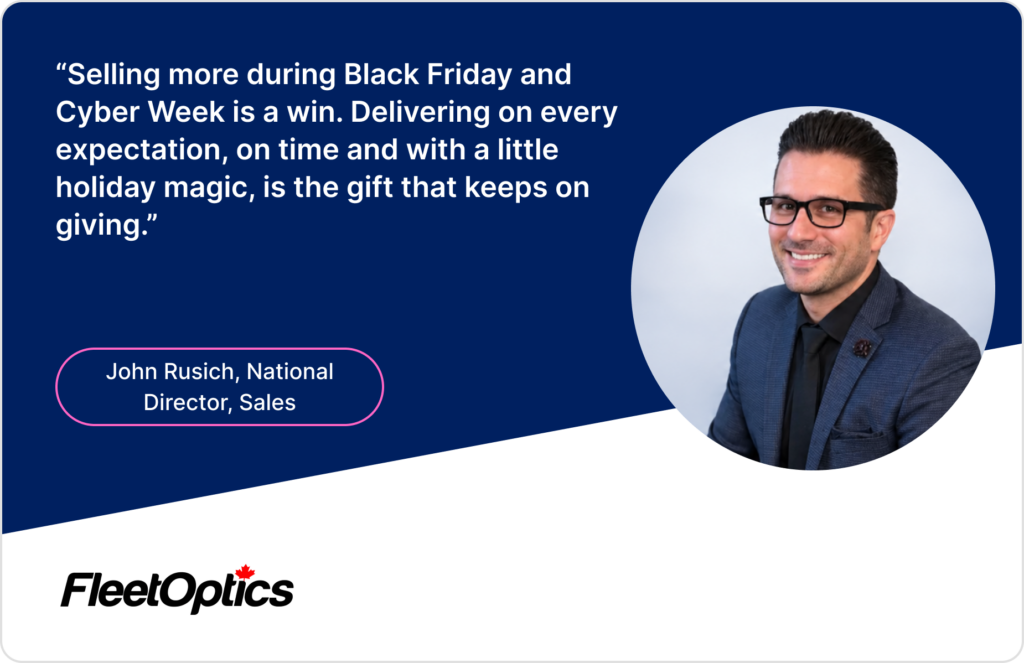

It’s the most wonderful time of the year!
And yes, I’m the guy who says that with a straight face every November. After more peak seasons than I care to admit (fuelled by more leftover Halloween candy than my dentist would approve of), I still get a little giddy when the volume starts to climb. Because peak isn’t just busy. Peak is where reputations get made for the next twelve months.
Here’s why the stakes are so high. Statistics Canada has found that November and December account for roughly 18% of all Canadian retail sales, and that’s with groceries and gas in the mix. Online, the peak is far steeper: in the U.S., about 30% of 2025’s e-commerce sales landed in the fourth quarter alone, and Cyber Week generated $44.2 billion in online sales in just five days. Closer to home, the 2026 RCC × Leger survey found Black Friday and Cyber Week are each expected to capture about 29% of Canadians’ holiday budgets.
That’s a lot of the year riding on a handful of days and for many retailers that share is considerably higher. So, no this is not the season to leave anything to chance.
This Year’s Shopper: More Online
The latest RCC × Leger survey paints a clear picture of the Canadian holiday shopper in 2026:
- Canadians plan to spend 42% of their holiday budget online, up from 39% – while stores still take the majority at 58%, and 61% say they’ll shop in person to see and touch products.
- The average planned spend is $911, down from $975 last year. Shoppers are being careful: 64% will hunt harder for deals and 43% are holding purchases for the big sale days.
- 88% rank Black Friday (November 27) among their top three shopping days, and 72% say the same about Cyber Monday – up from 64%.
Translation: shoppers are spending more deliberately, across more channels, and packing it into fewer days. Every order has to count. And so does every delivery.
It’s Not Just a Parcel. It’s a Promise.
Let’s not forget what’s actually inside those boxes. According to RCC, 86% of holiday budgets go to gifts for other people, with 64% going to immediate family. And 53% of Canadians say a memorable or meaningful gift matters most, more than twice as many as those who prioritize the lowest price.
That’s a first pair of skates. A sweater for a grandparent flying in for the holidays. The thing someone has been quietly saving up for since September. Nobody ever wrapped a tracking number – but every one of those gifts depends on one.
For the customer, the experience doesn’t end when they click “Buy Now.” In many ways, that’s when the most important part begins. They want to know their order has shipped. They want to know when it’s arriving. And above all, they expect the promise made at checkout to be kept.
Protecting that experience takes more than finding enough capacity to move extra parcels. It takes planning the entire post-purchase journey.
1. Make a Delivery Promise You Can Keep
Before we talk trucks, sortation or capacity, start with what you’re promising customers. What delivery date will they see at checkout? How accurate is that promise at peak volume? Are your order cut-off times realistic? What happens if volumes blow past expectations?
Peak is not the time to write cheques your delivery network can’t cash. A slightly more conservative promise you hit every time beats an aggressive one followed by delays and apologies. Even Santa only commits to one night.
Protect the promise first. Then build the delivery plan around it.
2. Forecast Volume and Plan for the Upside
Accurate forecasting isn’t just about capacity; it protects service levels and the customer experience. Share anticipated volumes with your fulfillment and delivery partners well ahead of Black Friday, including expected promotional spikes, geographic concentrations and any big changes from normal shipping patterns.
Then plan for the good news. If a promotion performs far better than expected, what happens to delivery performance? A promo that goes viral is a great problem to have, as long as it’s a problem you planned for.
The right question isn’t simply, “How many additional parcels can we process?” It’s: How many additional parcels can we process while still delivering the experience our customers expect?
3. Be Strategic with Promotions. Nobody Knows Your Customer Better Than You.
You know your customers better than anyone: who buys early, who waits for the doorbuster, who comes back every single year. Use that knowledge. Peak is the moment to keep your most loyal customers happy and to turn first-time holiday shoppers into next year’s regulars.
- Share your promotional calendar with your delivery partner so volume spikes are expected, not discovered.
- Stagger offers where you can, rather than stacking every deal into the same 48 hours.
- Reward loyalty with experiences you can reliably deliver – early access, clear delivery dates, and communication that makes customers feel looked after.
Winning the sale is great. Keeping the customer is the real prize. A smooth holiday delivery is one of the best retention tools you’ll ever have.
4. Make Tracking and Visibility Part of the Experience
Few things frustrate a customer more than not knowing where their order is, especially when it’s a gift with a deadline. Give customers clear, timely updates throughout the journey, make tracking easy to find, and communicate proactively whenever status changes.
Internally, visibility matters just as much. Retailers and delivery partners should be watching for exceptions and emerging pressure points as volume moves through the network. The earlier an issue is spotted, the more room there is to fix it before it becomes a customer problem.
The best customer service issue is the one that never happens.
5. Protect the Last Mile
Customers rarely distinguish between the retailer and the delivery company. If the delivery experience is poor, it reflects on the brand they bought from. A parcel that arrives when expected, with useful tracking and proactive communication, reinforces the customer’s decision to buy from you. A missed delivery or unexplained delay does exactly the opposite.
So look beyond network capacity. Evaluate the consistency and quality of the experience right at the customer’s door.
6. Yes, We’re Canadian. No, That’s Not an Excuse.
We know what a November storm on the 401 looks like. We know this is a big country, with a lot of road between some postal codes. None of that is news and none of it is an excuse.
Weather and geography are planning inputs, not alibis. What separates a great peak from a painful one is transparency, communication, collaboration and innovation. Before the first flake falls, retailers and delivery partners should agree on:
- Which issues require immediate escalation and who owns the response?
- How quickly delivery problems will be identified, and when the customer will be told?
- What happens if volume significantly exceeds forecast?
- Which contingency plans kick in if weather, capacity or routing gets tight?
A problem identified early can almost always be managed. A problem discovered when an unhappy customer calls your service team is already a customer experience failure.
We saw this firsthand during a labour disruption, when the resulting influx left other carriers capping customer volumes. We stepped in to help retail partners get holiday orders out the door, adapting quickly to their needs. For one partner, that meant finding a way to integrate their existing shipping labels into our systems, saving their team the time and resources required to relabel parcels. For others, it meant bringing on additional volume quickly to keep deliveries moving. Different challenges, same approach: collaboration, adaptability and practical innovation to protect the retailer’s operation and the promise made to its customers.
7. Take the Pressure Off Customer Service
More parcels can mean more “Where’s my order?” calls, particularly when tracking is unclear or delays aren’t communicated. That makes delivery communication part of your customer service strategy. Walk the journey from the customer’s side:
Order confirmed → Order shipped → In transit → Out for delivery → Delivered
At every stage, customers should understand what’s happening without having to contact you. Proactive communication frees your service team to focus on the customers who genuinely need help, instead of answering routine status questions.
8. Measure Performance Through the Customer’s Eyes in Real Time
Once peak is underway, operational volume is only part of the story. Ask whether the customer experience is holding up as volume climbs. Monitor on-time performance against the promise, delivery exceptions, first-attempt success, customer contacts and the recurring reasons behind delivery-related inquiries.
And don’t wait for January to react. Peak performance should be managed in the moment, not reviewed in a post-mortem.
Peak Season Is the Ultimate Litmus Test
Customers don’t see forecasts, capacity plans, distribution centres or route maps. They see one thing: Did the brand deliver on its promise?
This time of year is the ultimate litmus test, a chance not only to wrap up the year strong, but to add a little magic into the mix. The retailers who win aren’t the ones who simply move the most volume. They’re the ones who show up, communicate openly, work hand-in-hand with their partners and keep every promise they make.
At FleetOptics, we believe exceptional delivery experiences are built on visibility, communication, accountability and consistent execution, especially when the snow is flying and the volumes are climbing. We’ve been through enough peaks to know there’s no magic wand. But there is a playbook. And there is a team that loves this season as much as I do.
Selling more during Black Friday and Cyber Week is a win.
Delivering every one of those promises – on time, with a little holiday magic – is the gift that keeps on giving.
Sources: Retail Council of Canada, 2026 RCC × Leger Holiday Shopping Survey (October 2026); National Retail Federation, Winter Holiday FAQs.